

How to Choose the Right LED Strip Lights for Your Commercial Project
Choosing LED strip lights for a commercial project is very different from picking them for home use. Commercial applications demand higher reliability, longer lifespans, proper certifications, and consistent performance—often 24/7.
Whether you're lighting a hotel lobby, a retail store, a restaurant, or an office building, making the wrong choice can lead to flickering, color inconsistency, premature failure, and costly rework.
This guide will walk you through the key factors to consider when selecting LED strip lights for your next commercial project.
1. Start with the Application
Before looking at any technical specifications, ask yourself: What is this lighting supposed to achieve?
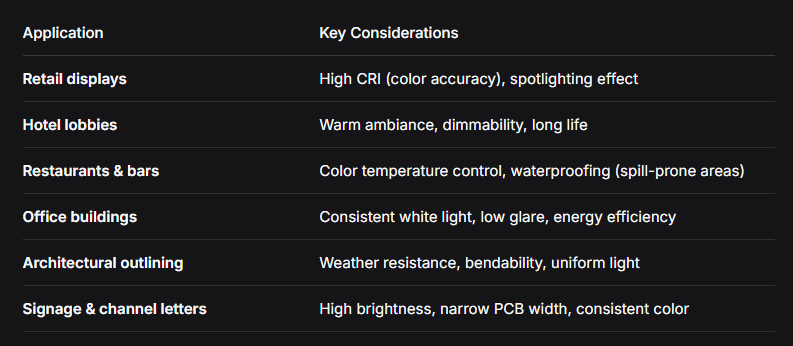
Pro tip: Always start with the end use case. The right product for a cold storage warehouse is very different from the right product for a luxury hotel lobby.
2. Choose the Right Color Temperature (CCT)
Color temperature affects mood, perception, and brand image. It's measured in Kelvin (K).
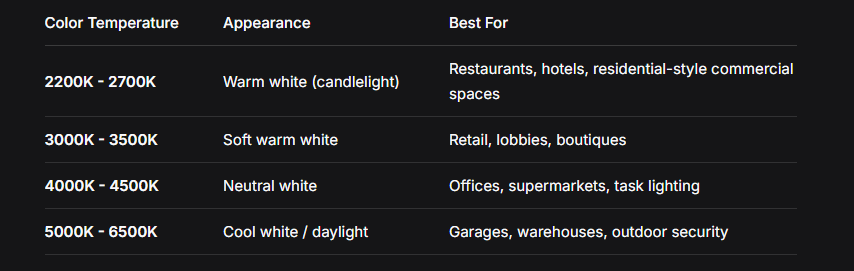
Pro tip: For commercial spaces, avoid mixing color temperatures in the same visual field. Consistency matters.
3. Don't Overlook CRI (Color Rendering Index)
CRI measures how accurately a light source reveals the true colors of objects. For commercial applications, this is critical.
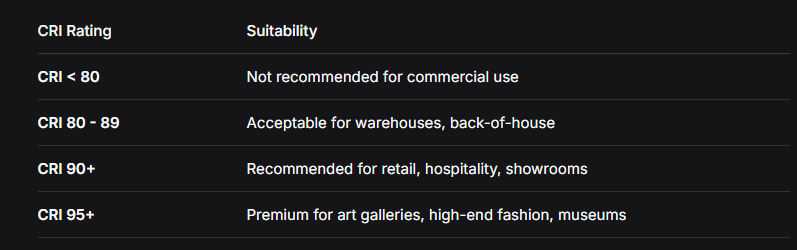
Pro tip: For retail displays featuring clothing, food, or artwork, choose CRI 90+ to make products look their best.
4. Select the Right Voltage
LED strip lights typically come in 12V DC, 24V DC, or 120-277V AC (line voltage). For commercial projects, low-voltage DC is generally preferred for safety and flexibility.
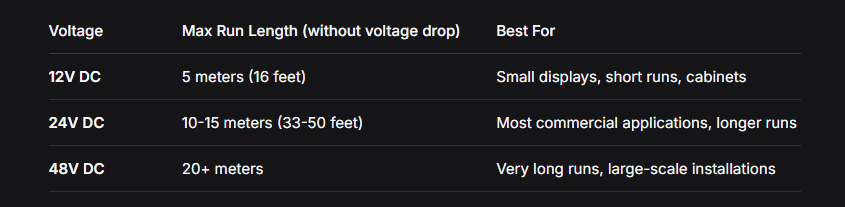
Pro tip: For runs longer than 5 meters, choose 24V or higher to avoid noticeable voltage drop (dimming at the far end).
5. Check IP Rating for Environmental Protection
IP (Ingress Protection) ratings tell you how resistant the strip is to dust and moisture.
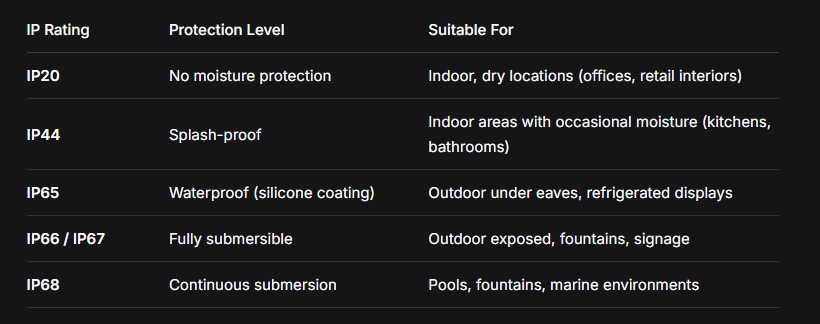
Pro tip: For outdoor commercial projects, IP65 is usually the minimum. For direct rain exposure, choose IP66 or higher.
6. Verify Certifications
For commercial projects (especially in North America and Europe), certifications are not optional—they're required for building code compliance and liability reasons.
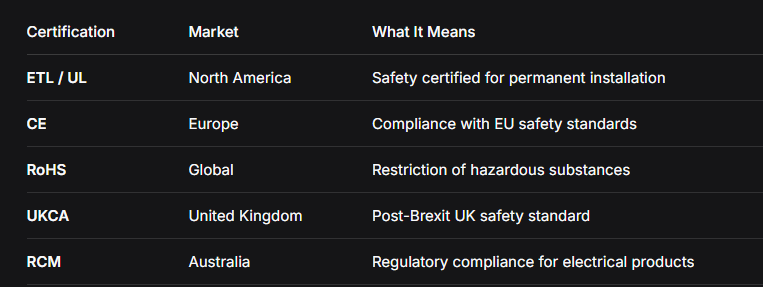
Pro tip: Always ask for certification documentation before placing a commercial order. Uncertified products can fail inspections and void insurance.
7. Consider Dimmability and Control
Commercial projects increasingly require smart control options.
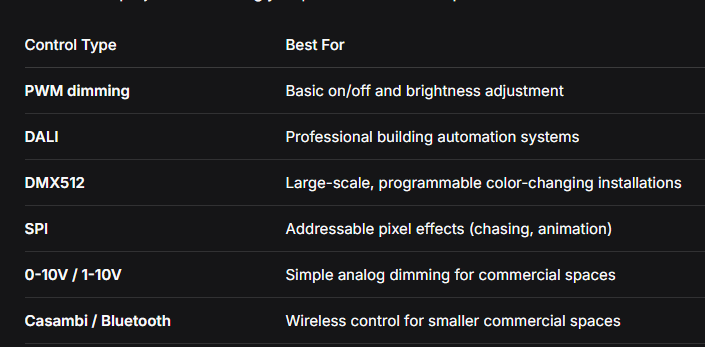
Pro tip: If you don't need color changing, focus on high-quality dimmable white (CCT-tunable or single CCT with smooth dimming).
8. Don't Ignore Lifespan and Warranty
Commercial LED strips should last 30,000 to 50,000+ hours. Always check:
Lifespan rating (L70 = time until brightness drops to 70% of original)
Warranty period (2-5 years is standard for quality products)
Heat dissipation (aluminum channels extend life significantly)
Pro tip: For 24/7 commercial operation, derate the expected lifespan by 30-40%. A strip rated for 50,000 hours may only last 30,000 hours if run constantly.
Quick Selection Checklist
Use this checklist when specifying LED strips for your next commercial project:
Application clearly defined
Color temperature selected (2700K? 3000K? 4000K?)
CRI 90+ for customer-facing areas
Voltage chosen (12V for short runs, 24V for longer)
Max run length confirmed (no voltage drop issues)
IP rating matched to environment
Certifications verified (ETL, CE, RoHS, etc.)
Control protocol selected (PWM, DALI, DMX, SPI)
Lifespan and warranty reviewed
Budget aligned with quality requirements
Final Thoughts
Choosing the right LED strip for a commercial project isn't complicated—but it does require attention to detail. The cheapest option almost always leads to the highest total cost of ownership when you factor in rework, downtime, and early replacement.
Still not sure which LED strip is right for your commercial project?
At Xuanan Lighting, we supply ETL, CE, and RoHS certified LED strips for commercial applications worldwide. Our team can help you select the right product based on your specific requirements—from voltage and IP rating to color temperature and control protocol.
[Contact Us Today] to discuss your commercial lighting project.