
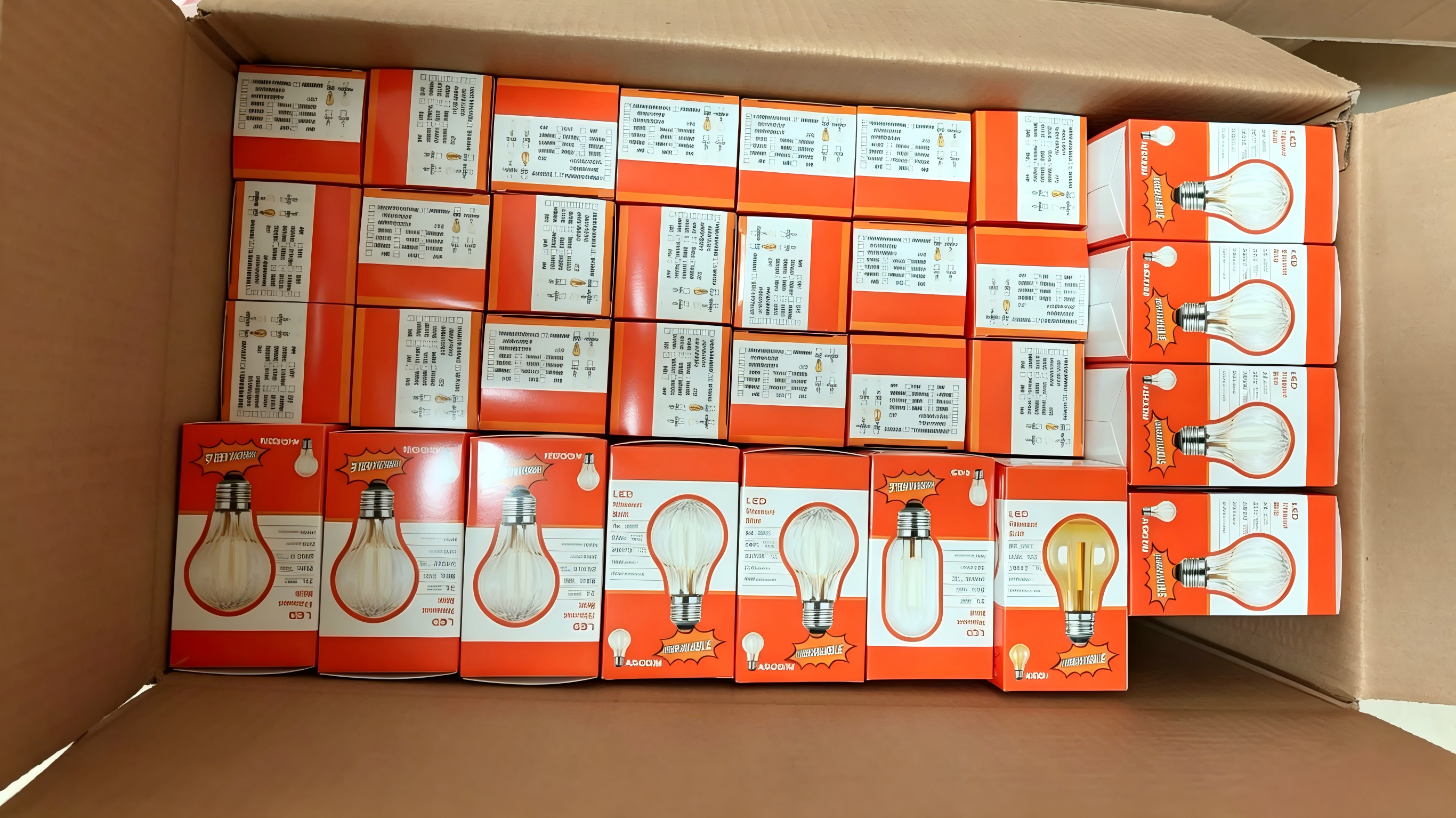
Understanding Volumetric Weight: A Lesson from a 2,500pcs A60 Bulb Order
When quoting shipping costs for LED products, most of us focus on the obvious factors: weight, distance, and shipping method.
But there is another factor that can catch even experienced buyers and sellers off guard: volumetric weight (also known as dimensional weight or DIM weight).
I recently learned this lesson firsthand through an order from my client Alvaro — and I want to share it so you can avoid the same surprise.
The Order: 2,500pcs A60 Brown Bulbs
Alvaro placed an order for 2,500 pieces of A60 brown glass bulbs with a specific requirement: a warmer color temperature of 1800K–2200K (softer and more amber than standard warm white).
The product itself was straightforward. The bulbs are lightweight — each one weighs very little. Based on actual weight, the shipping cost seemed reasonable, so I quoted Alvaro a relatively low freight charge.
But I made a mistake.
What Is Volumetric Weight?
Shipping carriers (air freight and courier services like DHL, FedEx, UPS) charge based on whichever is greater: the actual weight or the volumetric weight.
Term | Definition |
|---|---|
Actual weight | The physical weight of the package (how heavy it is on a scale). |
Volumetric weight | The amount of space the package occupies, calculated as: (Length × Width × Height) ÷ DIM factor |
For lightweight but bulky items, volumetric weight is often much higher than actual weight.
Example: A box of 2,500 A60 bulbs may weigh only 15kg actually, but due to the size of the box (bulbs take up space), the volumetric weight could be 30kg or more. Carriers charge for 30kg.
My Mistake: Quoting by Actual Weight
I calculated the shipping cost based on the actual weight of the bulbs — because that is what made sense to me. The bulbs are light, so shipping should be cheap, right?
Wrong.
When the carrier calculated the volumetric weight, it was significantly higher than the actual weight. That meant the real shipping cost was much higher than what I had quoted Alvaro.
Had Alvaro paid only the quoted amount, I would have lost thousands of RMB on this order.
A Grateful Lesson
After I realized my mistake, I explained the situation to Alvaro.
To my relief and gratitude, Alvaro was very understanding. He agreed to make up the difference in shipping cost — something he was not obligated to do.
I am deeply thankful for his trust and fairness. This experience taught me a valuable lesson that I will never forget.
When quoting shipping for lightweight but bulky items, always calculate volumetric weight first.
How to Avoid This Mistake
If you are sourcing lightweight LED products (bulbs, plastic housings, empty fixtures, etc.), follow these steps to avoid shipping surprises:
Step | Action |
|---|---|
1. Get package dimensions | Ask your supplier for the exact carton size (L × W × H) and the number of cartons. |
2. Calculate volumetric weight | Formula: (L × W × H in cm) ÷ 5000 = volumetric weight in kg |
3. Compare with actual weight | The carrier will charge whichever is higher. |
4. Request a shipping quote | Provide both weights to your freight forwarder or courier. |
5. Consider repacking | If volumetric weight is much higher, ask if the supplier can pack more efficiently. |
Quick formula reminder:
Unit | DIM Factor |
|---|---|
Centimeters (cm) | ÷ 5000 |
Inches (in) | ÷ 305 |
Example: A carton of 60cm × 40cm × 30cm = 72,000 ÷ 5000 = 14.4 kg volumetric weight
Products Commonly Affected by Volumetric Weight
Product Type | Why Volumetric Weight Matters |
|---|---|
LED bulbs | Lightweight but require protective packaging (boxes within boxes) |
LED neon tubes | Long length creates large carton volume |
Plastic housings | Very light but take up significant space |
PE rotomolded lights | Hollow but bulky |
String lights | Coiled on reels; packaging volume adds up |
Final Thoughts
I share this story not just to express my gratitude to Alvaro — but to help other buyers and suppliers avoid the same mistake.
Shipping cost miscalculations can strain relationships and eat into margins. By understanding volumetric weight, you can quote accurately, avoid losses, and maintain trust with your clients.
I am fortunate to work with understanding customers like Alvaro. Their fairness and kindness remind me that good business is built on mutual respect — not just transactions.
Need Help with Shipping Calculations?
If you are unsure about how to estimate shipping costs for your LED products — or if you need a supplier who is transparent about freight — we are here to help.
👉 Contact Us Today for accurate product pricing and shipping advice.