
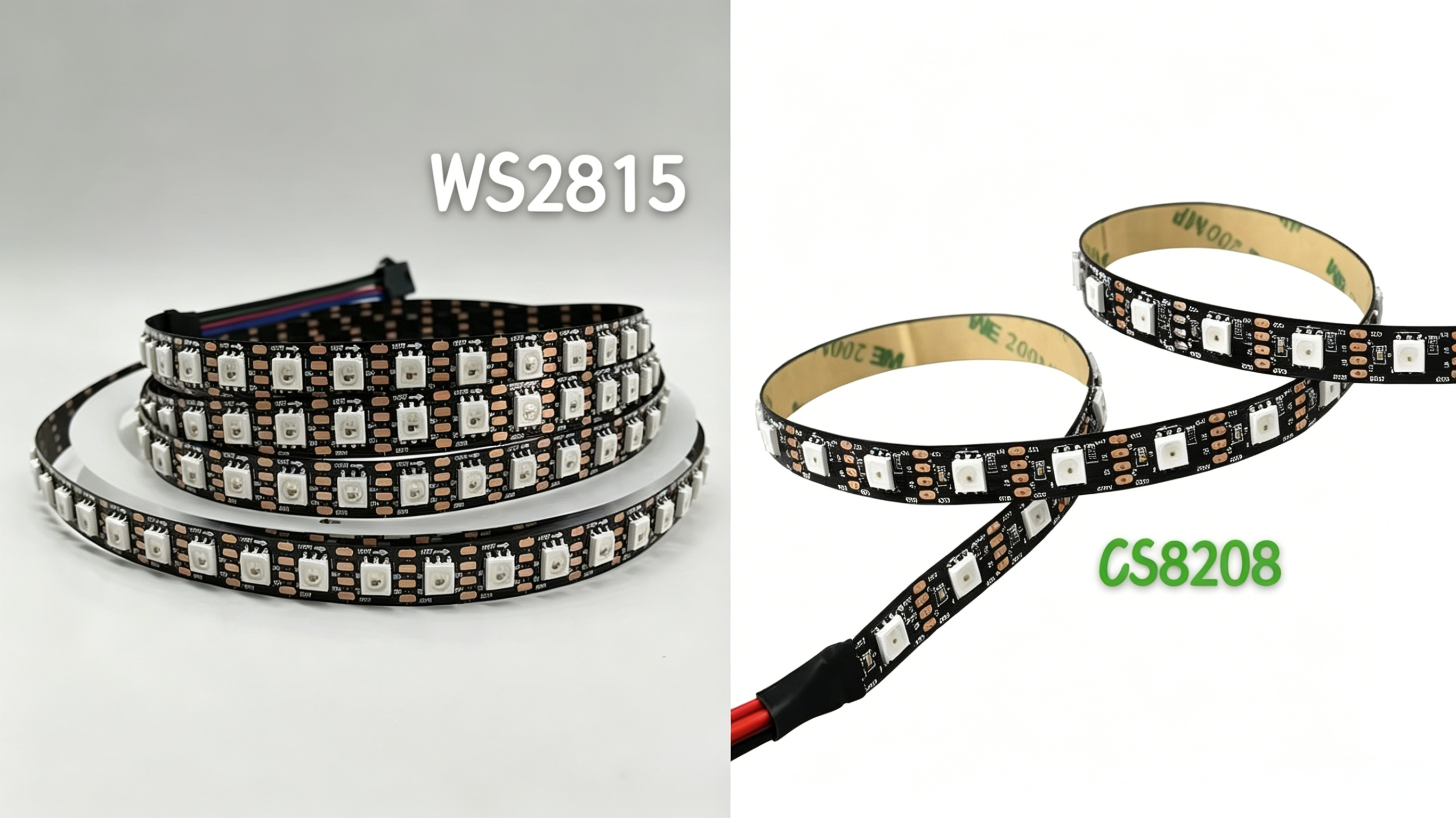
WS2815 vs GS8208 (Built-in): A Detailed Comparison for Addressable LED Strips
In the world of addressable LED strips, WS2815 and GS8208 are two popular 12V options often mentioned together. The market sometimes treats them as interchangeable, but is that really the case?
This article provides a detailed technical comparison between the WS2815 and the built-in IC version of GS8208, examining their internal design, performance characteristics, compatibility, and real-world application considerations. By the end, you'll understand their key differences and know which one is right for your project.
Quick Overview
Feature | WS2815 | GS8208 (Built‑in IC) |
|---|---|---|
Voltage | DC12V | DC12V |
Control Protocol | Single‑wire SPI (800kHz) | Single‑wire SPI (800kHz) |
Internal Architecture | Built‑in IC + resistors + capacitors | Built‑in IC (requires external resistors/capacitors) |
PWM Frequency | ~2 kHz | ~8 kHz |
Gamma Correction | No | Yes |
Break‑Point Continuation | Yes (dual signal lines) | Yes (dual signal lines) |
Color Performance | Standard | Superior (smoother low‑brightness transitions) |
Anti‑Interference | Standard | Enhanced |
Design Simplicity | High (minimal external components) | Moderate (external components required) |
Cost | Lower | Higher |
Architecture: The "Built‑in" Difference
The most fundamental difference lies in how "built‑in" is defined for each chip.
WS2815: Built‑in IC, Resistors, and Capacitors
The WS2815 integrates the control IC, resistors, and capacitors all within the LED package. This results in a cleaner, more compact strip design.
Advantages:
Simpler PCB Design: No need to place additional passive components on the strip.
Cleaner Appearance: Fewer external components give the strip a neater look.
Lower Production Cost: Reduced component count and assembly steps.
GS8208 (Built‑in IC): Built‑in IC, External Resistors/Capacitors
While the GS8208 is also available as a "built‑in IC" version (control chip inside the LED package), it does not integrate the resistors and capacitors. These must be placed externally on the strip's PCB.
Advantages:
Design Flexibility: Allows for the selection of specific external components to fine‑tune performance.
Potential for Higher Reliability: External components can be chosen for better tolerance and heat dissipation.
Key Takeaway: WS2815 simplifies design by integrating everything. GS8208 requires a more complex PCB layout but offers potential performance advantages.
Key Feature Comparison
Color Performance & Visual Quality
This is where the GS8208 has a clear advantage.

What Gamma Correction Means for You:
Without gamma correction, mixing colors at low brightness can result in a limited color palette and visible steps between colors. GS8208's built‑in gamma correction ensures that even subtle color gradients, like a sunset or a slow fade, are rendered smoothly and accurately.
Refresh Rate (PWM Frequency)

Why This Matters for Video:
For video recording and film production, a higher PWM frequency is crucial to avoid visible flicker and scanning lines. GS8208's 8 kHz refresh rate makes it much more reliable for high‑speed or slow‑motion shooting.
Anti‑Interference & Stability
GS8208 is designed with enhanced anti‑interference capabilities, making it less susceptible to electromagnetic interference (EMI) from devices like mobile phones or nearby electronics. WS2815, while generally stable, may be more vulnerable in environments with significant electrical noise.
Design & Circuit Simplicity

Compatibility: Can You Swap Them?
The chips share the same single‑wire 800kHz SPI protocol and are broadly compatible with the same controllers (like those running WLED, FastLED, etc.). However, compatibility is not 100% guaranteed.
A Critical Hardware Detail
For GS8208 to function correctly, the first chip's backup data input pin (often labeled D2 or BI) must be connected to Ground (GND) . If left floating or connected improperly, the controller may not be able to "find" the first pixel, leading to a non‑responsive strip.
Real‑World Example
Consider this scenario: A client requested a WS2815 strip for a project. To provide an upgrade, the supplier sent a GS8208 (built‑in IC) strip. However, the client's controller, expecting a WS2815, failed to drive the GS8208. The issue was likely that the GS8208's backup data pin (D2) was not connected to GND, preventing the controller from initiating communication. Ultimately, the strip had to be replaced with the originally specified WS2815.
Important Lesson: While they are compatible, replacing one with the other requires attention to wiring details. For a "plug‑and‑play" experience with no debugging, sticking with the exact specified chip is the safest approach.
Summary: Which One Should You Choose?
If you prioritize... | Choose... |
|---|---|
Cost‑effectiveness, design simplicity, and a proven, reliable solution | WS2815 |
Superior color quality at low brightness, ultra‑smooth gradients, and high‑speed video compatibility | GS8208 |
Enhanced anti‑interference and stability for demanding environments | GS8208 |
A "plug‑and‑play" experience with zero risk of wiring‑related troubleshooting | WS2815 |
Using a controller that hasn't been tested with GS8208 | WS2815 (to be safe) |
Final Thoughts
While often compared, WS2815 and GS8208 are distinct solutions. The choice boils down to your priorities:
WS2815 offers simplicity, cost‑effectiveness, and reliable performance for general applications.
GS8208 (built‑in) provides superior color fidelity, high‑refresh‑rate capabilities, and enhanced stability at a higher cost and design complexity.
If you are considering using GS8208 as a replacement for WS2815, it's crucial to have the wiring handled correctly or to offer it as a clearly communicated upgrade option. For a straightforward, risk‑free experience, the WS2815 remains a highly dependable choice.